
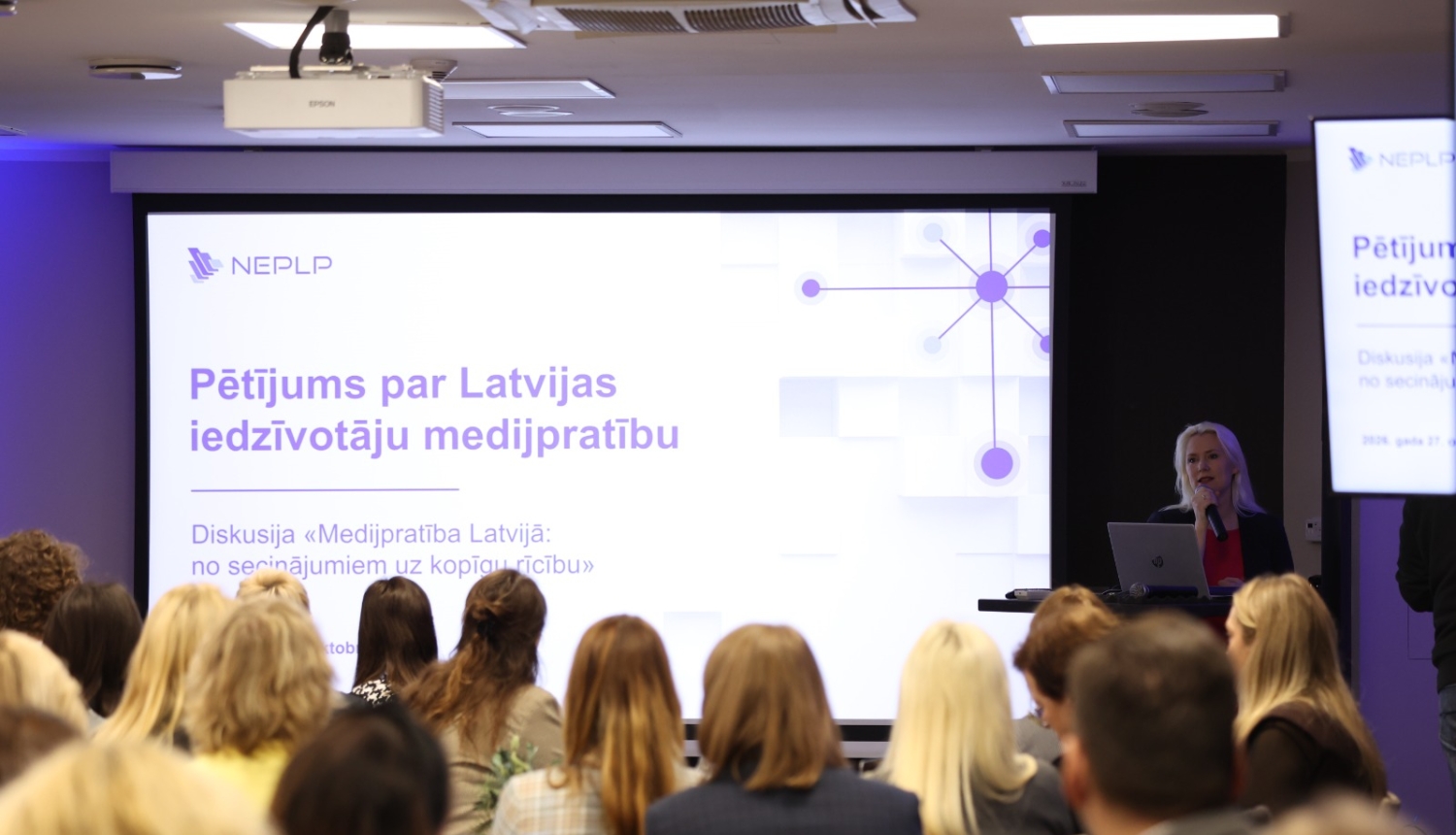
Media literacy in Latvia is improving, but the overall level remains moderate, according to a 2026 study by the National Electronic Mass Media Council (NEPLP). On a like-for-like basis, the media literacy score has risen from 5.7 to 6.4 out of ten since last year. Of the four indicators in the index, technological skills received the highest score, while content creation and engagement received the lowest.
The overall media literacy index for 2026 stands at 5.9 out of ten. This year, the index includes a fourth indicator: content creation and engagement. Only the first three indicators are directly comparable with last year’s results.
Results of the 2026 study:
| Indicator | Score |
| 7 |
| 6,3 |
| 5,9 |
| 3,3 |
“The findings show that media literacy in Latvia continues to improve, which is encouraging. People’s technological skills are improving, and they are gaining a better understanding of the media environment and becoming better able to navigate the information landscape. However, we cannot yet say that media literacy has reached a high level: the overall scores remain moderate. Continuing to strengthen critical thinking is particularly important, because knowing how to use digital technologies does not in itself mean being able to assess the reliability of information, recognise manipulation or make informed decisions,” says Aurēlija Ieva Druviete, Chair of NEPLP.
The study found that 21% of Latvia’s residents have a high level of media literacy, up five percentage points from last year. Scores tend to be higher among residents aged 54 and under, those with higher education and higher incomes, people living in Riga and those in families with children. Lower scores are recorded among people approaching or of retirement age, those with lower levels of education and income, people not in employment and members of ethnic minorities. However, the study also highlights an encouraging trend: both technological skills and critical thinking skills have improved markedly among older people and members of ethnic minorities.
Technological skills improve as people become more cautious online
People in Latvia have become better at using information technology tools and accessing information in every area assessed by the study. Internet use now stands at 98% among respondents, who are going online for an increasingly wide range of purposes and activities. Internet users are also paying more attention to security and privacy: the proportion who usually provide personal information online when asked has fallen to 17%.
More than half of respondents now use artificial intelligence tools
In the past year, 52% of respondents have used artificial intelligence tools, compared with 33% in 2025. Meanwhile, 55% say they know how to use these tools (+23% compared with 2025).
Negative news and information overload lead people to avoid the news
More than two-thirds of respondents deliberately avoid the news at least occasionally, with 35% doing so often or fairly often. Among those who avoid the news, 51% say it is too negative and emotionally distressing, while 49% cite information overload. Lack of time is cited by 34%, and the same proportion say the news causes anxiety or stress, or has a negative effect on their well-being.
Use of both public service and commercial media in Latvia is declining. Programmes from Latvia’s public service broadcaster are watched or listened to by 65% of respondents. This is the first time since 2019 that the figure recorded in NEPLP’s studies has fallen below 70%.
Seven per cent of respondents have created content on issues of public importance
In the past 12 months, 41% of internet users surveyed have created digital content, such as text, photographs, video or audio. Of those who created digital content during this period, 17% produced material on issues of public importance, such as the environment, security or health. This represents 7% of the full study sample. Nearly two-thirds of respondents (62%) scored below four on the content creation and engagement indicator. NEPLP Chair Aurēlija Ieva Druviete emphasises the need to encourage people to create content and play an active part in the information landscape: “A democratic society needs more than just consumers of information. It also needs active, responsible and knowledgeable participants in public debate.”
Strengthening media literacy requires a long-term strategy
The implementation plan for the Media Policy Guidelines for 2025–2027 sets out a coordinated, strategic approach to improving media literacy. It also calls for a policy concept report on introducing a long-term strategy to promote media literacy in Latvia. NEPLP regards this work as essential to making sustained, targeted progress. Existing research and data will provide a valuable foundation for developing the strategy.
About the study
The study was conducted in May and June 2026 by the market and social research company Latvijas Fakti to assess media literacy in Latvia and identify priorities for improving it. The representative survey involved 1,525 residents aged 15 and over from across Latvia. The study also included qualitative interviews with respondents aged nine and over. Combining these methods allowed the researchers to explore both how people assess their own skills and how they evaluate information in practice.
Further information about the studies is available in the Research section of NEPLP’s website.